

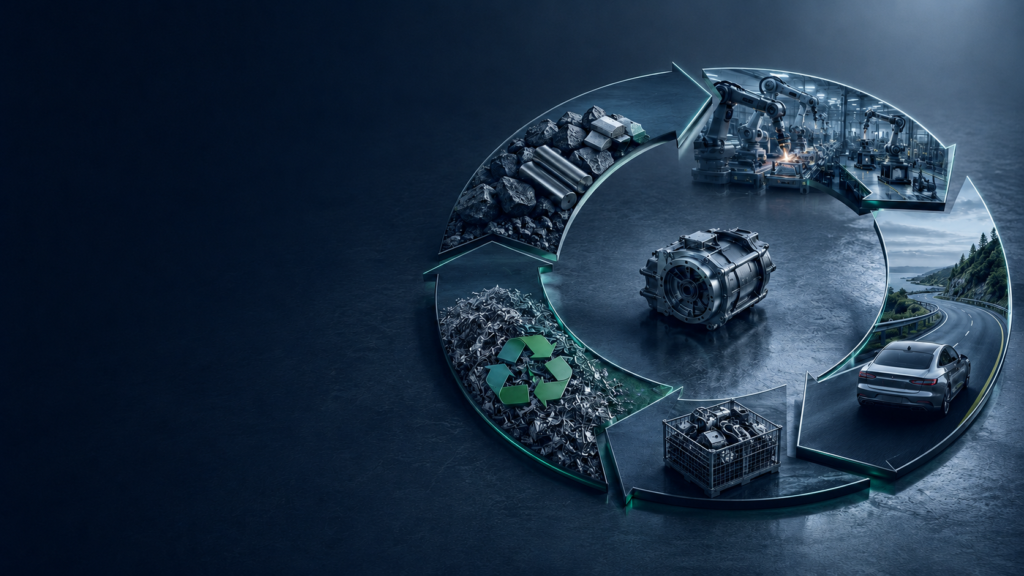
Our LCA consulting services support organizations in assessing the environmental impact of products across their entire life cycle, in line with ISO 14040 and ISO 14044 principles.
Life Cycle Assessment (LCA) is a methodology used to evaluate the environmental impacts of a product from raw material extraction and manufacturing through transport, use, recycling and end-of-life.
LCA helps identify the life-cycle stages and processes with the greatest environmental impact and provides an objective basis for improving product performance, material selection and process design.
When LCA consulting is useful
LCA consulting is useful when an organization wants to understand the actual environmental impact of a product, compare materials or process alternatives, support eco-design activities or respond to customer requirements regarding environmental data.
The assessment can also support circularity strategies, emission reduction initiatives, supplier selection and product-development decisions.
Main stages of an LCA study
Goal and scope definition – we define the purpose of the study, the intended application of the results and the scope of the assessment;
Functional unit and system boundaries – we establish the basis for comparison and determine which processes are included;
Life Cycle Inventory – we collect and structure data on raw materials, energy, transport, processes, emissions and waste;
Life Cycle Impact Assessment – we evaluate the contribution of the inventory to relevant environmental impact categories;
Interpretation of results – we identify significant processes, environmental hotspots and improvement opportunities.
What an LCA can reveal
- contribution to climate change;
- energy and resource consumption;
- impacts associated with raw materials and manufacturing processes;
- influence of transport and packaging;
- benefits of reuse and recycling;
- potential transfer of environmental impacts from one life-cycle stage to another.
Our services
GAP analysis and study definition – we clarify objectives and assess the availability of the required data;
Functional unit and system boundary definition – we establish the methodological basis of the assessment;
Data collection and verification – we review process data and evaluate consistency and completeness;
Life Cycle Inventory development – we structure the relevant inputs and outputs for the product;
Environmental impact assessment and interpretation – we analyze the results and identify environmental hotspots;
Improvement opportunity identification – we highlight opportunities to reduce environmental impacts through materials, processes, logistics or product design;
Documentation preparation – we support alignment with ISO 14040 and ISO 14044;
LCA training – we prepare responsible personnel to understand and apply the methodology.
What we verify in practice
We review data quality and traceability, system boundaries, calculation assumptions, data representativeness, significant processes and the consistency of the interpretation.
The objective is to ensure that the LCA provides useful information for real product decisions rather than only a theoretical result.
We transform product data into a clear picture of environmental impacts and practical input for decisions related to design, materials, processes and circularity.
LCA – understand the impact, improve the product.